
Game Overview
Game concept: First person role-playing game.
Genre: Psychological thriller.
Target audience: 18+.
Goal of the game: To search for ingredients to create the elixir that would effectively destroy Hyde’s existence. Side goal – to find the origins of Hyde.
Look and feel: 16th century renaissance Italy.
Background: Abusive childhood, father did not have a handle on aggressive emotions, also a drunk.
Gameplay
Progress: finding clues and winning boss fights, finding ingredients for potions
Mission/Challenge structure: So mission remains the same throughout game, and gets more challenging the further you progress.
Main objective: To find the ingredients of the elixir that will ultimately keep Hyde dormant.
Secondary objective: To find the origins of Hyde’s existence.
Play flow: After a certain task has been completed or when a key item is found, a new level area unlocks. The game world, as with the story world, can only function within set limitations in terms of story progression. This ordering of levels and challenges is akin to the ‘modes of organization’, which could also be construed to be one that is ‘not found in the world but built into a world’ (Goodman 14).
- When Jekyll transforms into Hyde, the screen becomes static and begins to glitch, and the player is sucked into a different dimension where the world changes into one that is sinister and dark. The magnificent buildings that we see in Jekyll’s world are now worn and dilapidated. This vast contrast between the two perspectives of Jekyll and Hyde is an example of how one world can be experienced differently depending on ‘the frame of reference’ in which it is described and as Goodman elaborates, ‘Our universe, so to speak, consists of these ways rather than of a world or of worlds’ (3).
- When in the vicinity of common townspeople, Hyde will be mobbed and attacked; and as Hyde is a much more primal person his only options are to run, hide and fight.
- Every time you turn you have to win a boss fight to turn back to Jekyll and progress
- As Jekyll you walk around and search for clues to the origin of Hyde and collect ingredients and brew potions to keep Hyde at bay.
Mechanics:
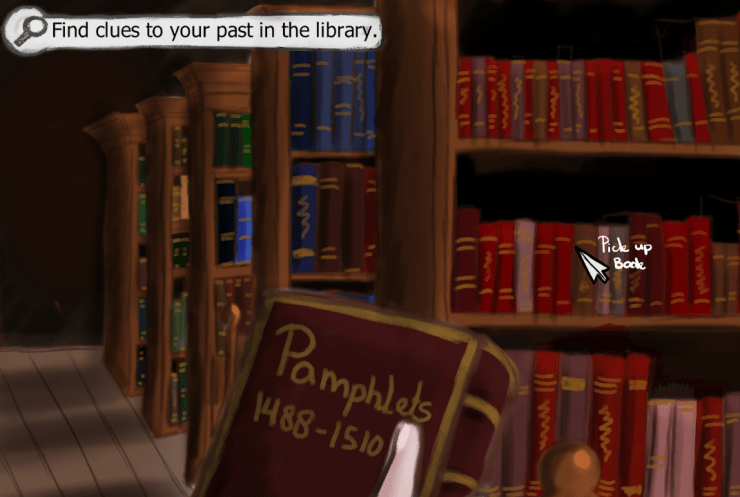
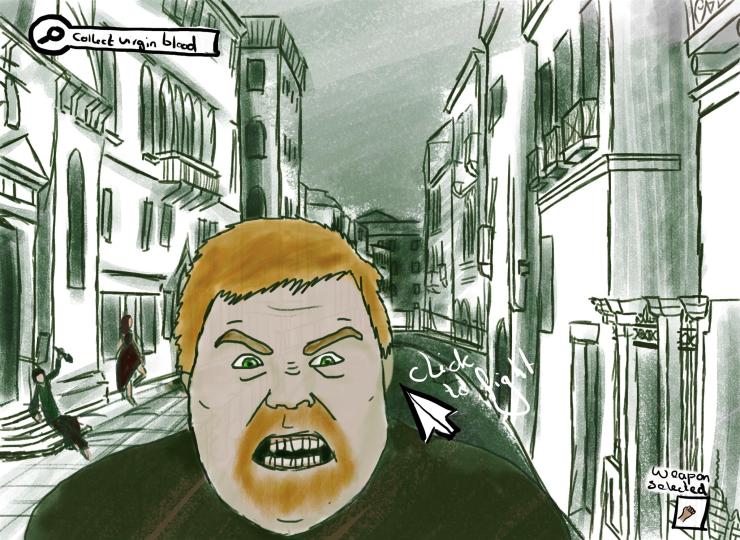
- First person role-playing game
- Physics: Only able to touch and pick up clues, weapons and ingredients/collectible object (they appear in the inventory). We are able to use chairs to sit, tables and ladders to climb. Limitations: you have one weapon-slot, Dr. Jekyll cannot use weapons but can purchase them on the “market”.
- Objects: Collect ingredients for potions to delay transformations and as the game progresses the need for more potions increase. Objects can be collected by clicking on them. You have an inventory for the objects you accumulate and a progress bar for the ingredients for the final potion.
- When the player controls the character of Jekyll, the items he collects are commonplace objects (eg. medicinal powders and liquids)
- When the character morphs into Hyde, items that are collectible take on a more grotesque nature (eg. blood, toenails)
This ‘pendulum’ form of gameplay, that is, the changing of themes as the player alternates between characters, proffers players the opportunity to explore each respective world in the manner with which each character experiences. Accordingly, as the world that Hyde inhabits is one that is hostile compared to that of Jekyll’s, these ‘changes are reshapings or deformations that may according to point of view be considered [to be] either corrections or distortions’ (Goodman 16).
- You can’t enter every building except for buildings that have clues and objects in them. You can move into a building where people reside and talk with them, also some buildings are unlocked after you get certain clues and “levels”.
- Actions: WASD-keys for movement, clicking to interact with objects, means of communications click on person and then you get conversation options to select from. With people who have clues you can unlock the information by leading the conversation a certain way.
- Combat: Point and click fighting, with automatic loading bar for combos.
- Movement in the game: WASD-keys for walking, mouse for controlling camera movement (what you are looking at).
- Economy: trading objects and money at “market” to get products.
- Game(ending) options:
- How the game ends is dependant on the outcome of the final fight between Jekyll and Hyde
- Replaying and saving: auto-save after a boss-fight and if you die in a bossfight, you have to restart the bossfight.
- Easter egg ideas: Renaissance painters.
Story, setting, and character
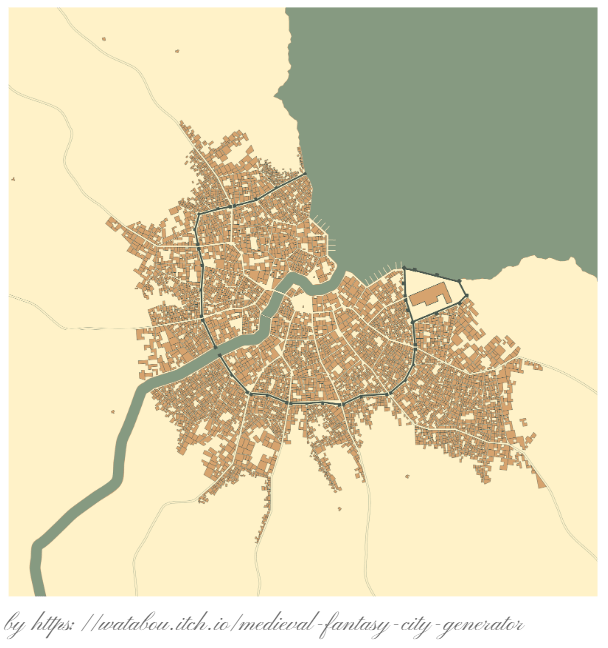
City name: Aurelia
River name: Venus stream
Sea: Adriatic sea
- Cutscenes:
- Opening scene (tutorial): The year is 1550, in Renaissance Italy. Enrico Jekyll is seen rousing from a deep sleep in a messy boudoir. There is a dead prostitute lying on the floor next to the front door. Jekyll looks around in disbelief, unable to remember how and why he got there. A montage of flashbacks of a woman screaming and crying. Jekyll is suddenly hit by a massive headache and he groans, with his head in his hands.
He gets up from the floor and walks over to examine the prostitute.
Close up: Body of prostitute which is spread eagled and splayed open from chest to the navel. Jekyll gasps and mumbles: ‘Wha…?’
cue tutorial: Jekyll learns basic stealth movements and other basic actions to move the body away from the door and flees the brothel unseen
-
- Scene prior to the final fight: Dr Jekyll’s quest finally leads him to his old family home where he finds Caterina’s butchered body in the pantry closet. As he cradles her head in his arms, he notices old bloody scratch marks near the base of the door. As he examines further, he begins to have flashbacks of himself beaten and thrown into the pantry as a young boy. Just as he is about to rouse from his terrible vision, a shadow of Mr Hyde flies past him into the drawing room. Here, Jekyll is forced to confront his inner demon when he sees the image of Hyde reflected in a large brass mirror. Before he engages Hyde in the final showdown, the image of Hyde begins to morph into the image of a man (who wears the same clothes as Hyde) who asks “What, you’re not happy to see your father?” Jekyll falls to the ground where he sees more flashbacks of his father brutally beating him and raping his mother. The pain is too much to bear and he screams “NOOOOOOO!!” before moving in to strike Hyde. (the final fight begins)
Tygstrup has posited that ‘a simple, stated fact rarely makes sense by itself’ (87). We are aware that Hyde is a manifestation of all that is corrupt in Jekyll, and we have, as such, added an additional dimension by exploring a possible causality between his traumatic childhood and his ‘unburdening’ of suppressed rage that is Hyde. ‘Symbolic forms are interpretative schemes that can turn whatever we apprehend and what happens to us into useful discovery’ (87), and in this case, the similarity between Hyde’s and Jekyll’s father’s clothing is, in a way, a symbolic form that reveals the source of Hyde’s existence. Other examples would include the symbolism of violence (ie. childhood abuse), and the symbolism of the pretenatural in Hyde’s world as a representation of a time and period long past (ie. Jekyll’s childhood).
- End scene (alternative 1 – Hyde defeated): Hyde falls to the ground, gasping for air as hundreds of ghoulish hands reach out from the earth below and tears his body into pieces which they then drag down to the 7th circle of Dante’s hell. As Hyde is being torn into pieces, Jekyll’s soul bursts out in a shower of stars as he floats up and towards the sky.
- End scene (alternative 2 – Jekyll defeated): Jekyll falls to the ground, gasping for air as bloody green pustules start forming on his face as he morphs into Hyde. Hyde gets off the ground and grins lasciviously as he prepares for a jaunt out.
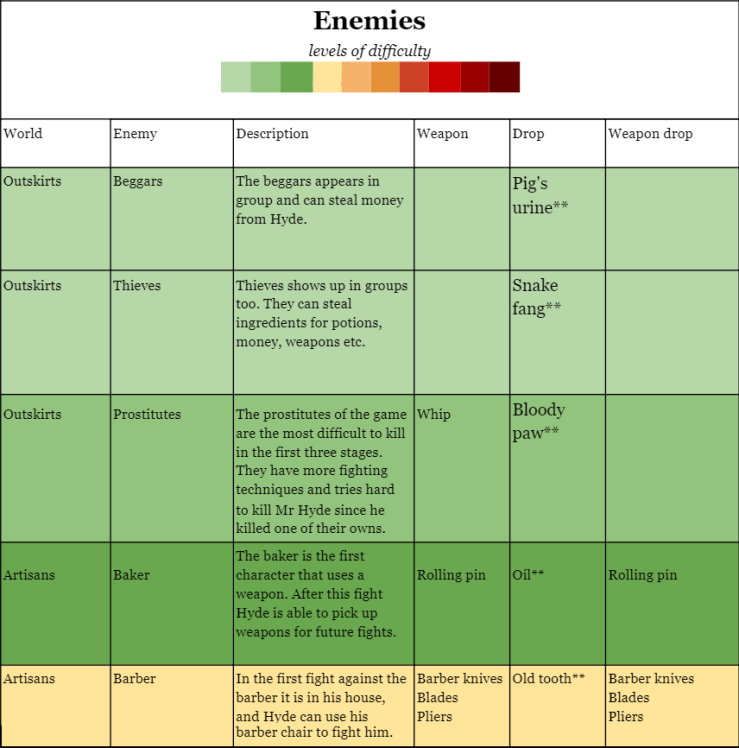
Enemies
As with any game, there are certain enemies that you must fight to progress. There are different enemies in each ‘world’ and different levels of difficulty. Some enemies fight with ‘weapons’ and usually, once a fight is finished, you earn the weapon they have been fighting with, signified by Weapon Drop. After a successful fight, you will also earn a certain Drop, which is an ingredient for the potion. Once an enemy is defeated in a certain world, it can reappear in a new world, however with the same level of difficulty as before.
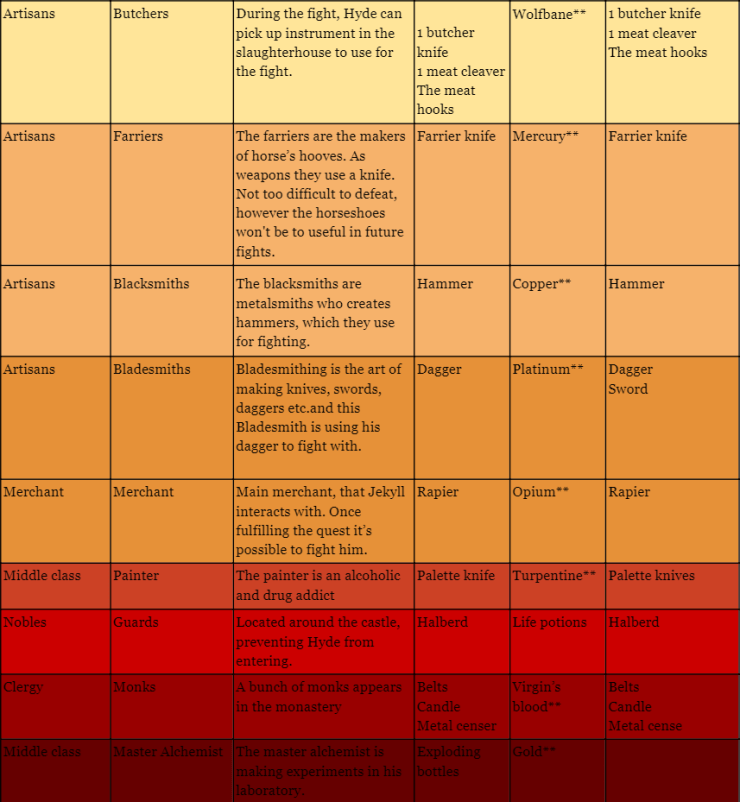
Clues given in the game:
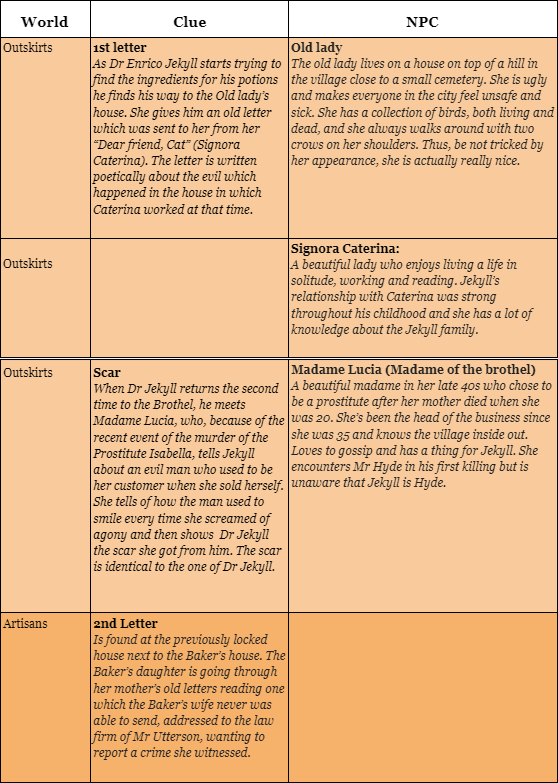
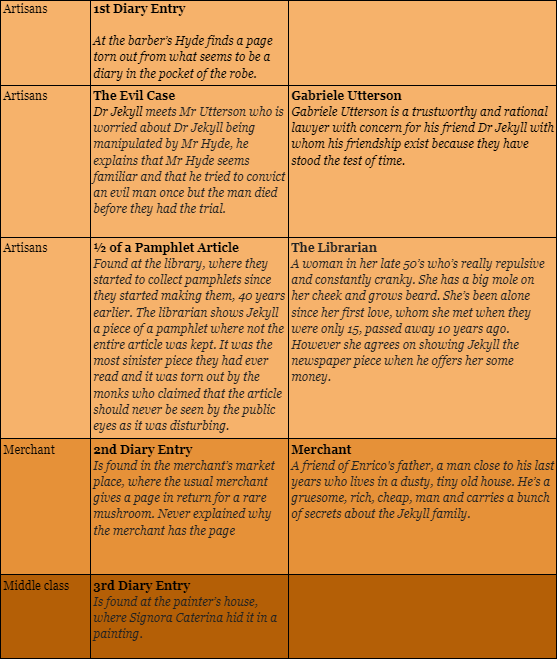
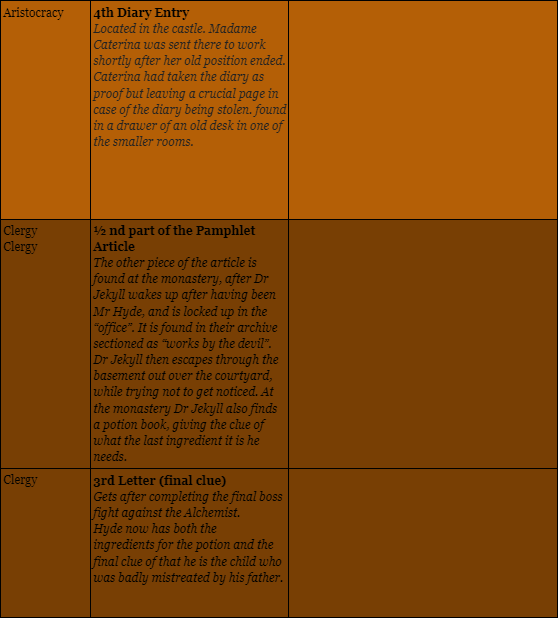
In the game you find a total of 10 clues:
- 4 Diary entries by Mrs Jekyll and Signora Caterina hide in different locations around the game worlds.
- 1 Pamphlet article
- 3 Letters
- 1 Scar identical on Madame Lucia
- 1 Judge case by Mr Utterson
The Diary Entries were written by Mrs Jekyll and she gave them to Signora Caterina when she died to still have proof of everything that happened to the family. Signora Caterina then scattered them through town to keep them hidden if something else happened.
The Pamphlet article is split in two halves. The letters have two different authors, Signora Caterina and The baker’s wife. The clues are relevant for Jekyll to find out what happened to him in his younger years and why it is Hyde he turns into.
Keeping in mind that it is the prerogative of Jekyll to seek the truth, these clues are only meaningful and accessible to him in his world. It is in this way that this aspect is understood to be more relevant to Jekyll than it is to Hyde, which is in tandem with Goodman’s hypothesis ‘that two worlds contain just the same classes sorted differently into relevant and irrelevant kinds’ (10)
Main Characters
character interview of Dr Enrico Jekyll and Mr Eduardo Hyde
Biography
Personal history: See background of the game.
Strengths: As Dr. Jekyll, his brain, his calmness and rationality
As Mr. Hyde, his physical strength and his ruthlessness when it comes to survival
Weaknesses: As Dr. Jekyll, his unwillingness to ask anyone for help to not have scandal associated with his name, the repressing of his feelings.
As Mr. Hyde the strength of his “ape brain”, not really being able to use his brain very well, very simplistic and primal actions.
Two defining moments: first, the moment he changes into Mr Hyde the first time. Second, when he arrives at his childhood home and realising that Mr Hyde is a reminiscence of his childhood abuse.
Story arc: Again see the background of the game
Backstory:
Enrico’s childhood was an unhappy one. His father died when he was a young child of eight and he was left in the care of his suicidal mother and his nanny Caterina. Throughout his young life, his mother was emotionally detached and distant. The only person he depends on is Caterina who nurtures him as if he was her own. At age 17, Enrico leaves his family home and sets off to the city to be an apprentice at an apothecary. Shortly after he leaves, his mother kills herself leaving behind a cryptic message on the wall (written with her feces) “Don’t look”.
After his brief apprenticeship, Enrico is recognised for his uncanny talent in obtaining and concocting potions and is soon accorded with the Crown’s seal as Master Apothecary. Jekyll is soon commissioned by the Italian Crown to develop a cure for syphilis (which they call the ‘French devil’). Due to the King’s deteriorating condition, Enrico is pressured by King’s Courtiers to complete the potion within a stipulated time, failing which, he is punishable by death. As the day draws nearer, Enrico is desperate to find a cure for the condition. In order to test the possible harmful side effects of his formula, Enrico downs a vial of his potion. He is immediately overwhelmed with darkness. He finds himself incapacitated and bound by the throes of a fiery rage that he never knew existed within him..
When he wakes, he finds himself in a boudoir with a dead prostitute in the room. He begins to have flashbacks and realises that he may have been involved in the killing of the prostitute. Fearing for his life and his sanity, Jekyll flees the brothel back to the safety of his laboratory where he starts having more flashbacks. He grapples with the memory of the murder and remembers the rage that had taken completely over his faculties. Jekyll is distressed and decides to call in on his mentor, Rodrigo. Upon hearing Jekyll’s story, Rodrigo reveals the existence of an elixir that acts as anti-metastasis. In order to keep Hyde at bay, Jekyll has no alternative but to go on a quest to hunt for the cure.
As he journeys through the city, he encounters people of different social classes in that period. (add commentary on bourgeoisie/working classes) Finally, after he defeats the Master Alchemist and obtains the final ingredient, he realises that the elixir is completely useless. Jekyll, acting upon the final words of the Master Alchemist, is led back to his childhood home where the truth about Hyde is finally revealed. To Jekyll’s shock and horror, Hyde is and has always been, the manifestation of his repressed memory of his abusive father. In order to destroy Hyde, Jekyll must confront and defeat his inner demons by way of fighting Hyde physically. However, he soon realizes that killing Hyde would be suicidal for he, Jekyll, and Hyde are one and the same. On the other hand, failure to destroy Hyde would result in a final metamorphosis where Jekyll will cease to exist and Hyde will be free to terrorize the city.
Our alternative approach to Jekyll and Hyde is a decomposition of Stevenson’s Dr Jekyll and Mr Hyde which we have (re)composed by adding different dimensions to its setting and to the character development of Hyde. The premise of Dr Jekyll and Mr Hyde is popularly known for its theme of duality and it is understood that Mr Hyde is borne out of Dr Jekyll’s desire to live a hedonistic lifestyle without apology or guilt. This aspect of the story could, in our view, be fleshed out even further and as we have demonstrated, ‘the making of one world out of another usually involves some extensive weeding and filling – actual excision of some old and supply of some new material’ (Goodman 14). For the purpose of giving dimension and depth to Hyde’s character, we have deleted Stevenson’s original take on Hyde by supplementing Jekyll with a history worthy of a Freudian study.
Setting: Urban society in Renaissance Italy.
In the era we chose medicine and science are present, but religion was still popular. Therefore, it would be a credible setting for our game without changing too much of the original story. Although the Renaissance is the “rebirth” era, the Church has an important role in society as well as a huge influence. So if you contradicted or didn’t follow their principles you risked death. Basically, your daily life was controlled by the Church. In our view, it represents the “dark” aspect of that time period, due to the life or death right over individuals from the Church.
Game world:
Feel and look:
As described in the section titled Play flow, the world changes drastically into a darker and more sinister one when Jekyll takes on the form of Hyde.
In the centre of the city lies the cathedral and a close by the monastery. In addition, the big square around is used to host the market. The nearby one-storey wooden houses of the artisans are followed by the neighbourhoods of the rich merchants that have built for themselves two-storey stone houses. The city has grown rapidly in recent years thanks to the boom in maritime commerce and as a result of its quick expansion, the streets winding within the city are narrow but are kept neat. Also, they are covered by cobblestones making it more passable. On the outskirts of the city live the poor and the outsiders of the society. It is a mix of fragile huts made with scraps of material some of which house brothels. The air is filthy as people throw everything onto the muddy streets. By the sea, stands the castle which is fortified by a tall wall that surrounds it and guarded by four watchtowers. There is a long moat that surrounds this tall wall and for visitors to enter, they are required to go over a drawbridge. This image of Renaissance Italy is a representation of our acquired knowledge of that era as ‘worldmaking as we know it always starts from worlds already on hand; [and that] the making is a remaking’ (Goodman 6).
Areas/Stages:
stage 1-3
You start the game in the outskirts of the city. Those sequences happen in the city streets. It is muddy, the houses are crumbling, made with scraps. There is no order, houses have been built in a chaotic way so the streets are like a maze.
stage 4
Once you are done with the first 3 stages, you will arrive in the city. You are now in the neighbourhood of the artisans.
You can see a one-storey wooden house with two windows. Outside hangs a sign where a bread is drawn as we are at the bakery. Inside, there is a wooden floor of a light colour, we can see the counter with a scale on it as well as shelves on the wall were the bread lies. Behind the counter, you can catch a glimpse of the baker’s oven. There are stairs next to the oven leading to the basement. The baker uses it to store his ingredients to bake the bread and his tools.
stage 5
A little one-storey wooden house. Outside hangs the sign where a barber knife is drawn as we are at the barber shop. There is one rectangular window but as it doesn’t bring much light there are candles on the table that is against the wall on the left side of the room. Apart from the candles, we can observe the different tools that the barber-surgeon uses in his daily activities: a small blade used for bloodletting. That is why there is a small basin under the table. A barber knife to shave faces or tonsures, and finally pliers to extract teeth. In fact, the barber kept a jar filled with some teeth by the window so people know he performs dentistry. In front of the table, there is a simple wooden chair for his customers. On the right wall hangs on a hook the barber’s white short robe. It is not strictly speaking clean as some blood stains cover it here and there.
stage 6
One big storey wooden house. Outside hangs a sign with the head of a pig as we are now by the butcher. The house is divided into two rooms that are adjoining. The first room is where they sell the meat. On each side of the entrance door, there is a window. The wooden floor is not very clean as there is still a bit of blood on it. On the walls hang the different types of knives the butcher uses. You see now the counter, there are a big scale and some other knives. The meat is presented to the customers by hanging it on metal hooks but now they are empty as it is the end of the day. Still, you can see six of them. Behind the counter, there is a door that leads you to the slaughterhouse. It is a bigger room, the light comes through 2 roof windows and one 1 window on the opposite side of the door, therefore it is a bit dark inside. From the roof hang a row of metal hooks. Against the left wall there are 2 wooden tables where they cut the meat and above them, there are knives on hooks. Looking at the right wall we notice a barrel filled with water and next to it two brooms to clean the wooden floor that starts to be worn out by dint of washing it.
stage 7
As we arrive by the smiths, we are in an outdoor setting. It is a medium size square, with cobblestones. There is a well on one side of it and each of the Smiths has their stands built with stones and a straw roof but no walls around. On the pillars, they hang their tools and have a table to showcase their work. In the middle of each stand, you can see a forge, anvils and slack tubs, so they can shape the metal and produce the tools, as well as a bucket of water. They are spread around the square so Hyde will walk from one to the other.
stage 8
We are over with the artisans and will continue in the merchant’s area. The house of the richest merchant of the city is built with grey stones, the roof has black clay tiles and has two stories. On each side of the richly decorated entrance door, there are two rectangular windows. When you enter, the ground floor is where he exposes the valuable goods. The shop consists of a counter, many shelves and boxes. The wood used for the floor is more precious than those in the shops of the artisans and of a darker colour. Behind the counter, there is a wooden door through which we can discover the stock of products piling up in an orderly manner. Finally, to access the family quarters, you will need to use the staircase outside of the building. Outside the shop hangs a sign with the family coat of arms to identify his shop. It has a black horse on a red background as they used to be horse merchants.
Here you also find a school and the library. As literacy is seen as being from high class, both the school and the library are beautiful buildings which the monks built to educate the children through the church’s perspective.
stage 9
We are in another area of the city, close to the castle where a famous painter lives. To reach the house, there is a road bordered by trees. It is a one-story grey stone house with a roof made of red tiles. A row of windows stretch along the front of the house and in the middle, there is an arch where the entrance wooden door is nested. You can notice how richly decorated she is. A chestnut dark wood has been used to make it. There are several rooms as it is as well the family house. Though, the right wing is solely dedicated to the painter. The studio composed of many windows, as he needs the light during the day to paint, is encumbered by the material and the utensils for the painting. One of them is broken and still needs to be repaired. At the back of the room, stand plasters serving as a model and against the wall on the shelves lie the fabrics used in the stagings of portraits.
stage 10
We have reached the castle. He is surrounded by walls together with four towers. To enter, you need to go through the drawbridge. The castle is built in grey stone. The main building with two stories has the roof in lead and with some decorative motives around the windows. The ground floor is composed of rooms dedicated for an official use, like the throne room, the ambassador’s room or the ceremonial room as well as the kitchen. Instead, the upper part is assigned to the private chambers of the aristocrat and his family. A beautiful marble staircase allows you to access it.
stage 11
We are back in the city as the guards are looking after Hyde. Hyde enters into the monastery built in the centre of the city. It is a rectangular building of stone with grey clay tiles on the roof. In the middle, there is a courtyard, in which stands the well. Some fruit trees have been planted as well as a herb garden composed of culinary and medicinal herbs. The church is located in the left wing with the adjoining library. Whereas the right side is dedicated to the dormitories and the kitchen. From the kitchen, there are stairs that lead you to the cellar, in which the monks store their food as well as the beer.
stage 12
In between the area of the artisans and the merchants lives the alchemist. It is a two-story stone house but of a smaller size of those of the merchants. On each side of the entrance door, there are small windows. Once you enter, you can see his bedroom, living room and the kitchen. From the outside staircase, you reach his laboratory. It is a big room, with two windows and a roof window. The wooden floor is stained and sticky due to the potion that sometimes falls on it. The furniture is scarce as he only needs a big table and a chair. He prefers to install all around the room shelves where to stand his potions and ingredients. Although, he has a cupboard, next to his desk, to store his precious ingredients. Each night he closes it and keeps the key around his neck. In the middle of the room, you see the fireplace, with logs pilling up next to it and a bellow. While the fireplace poker is leaning against the wall. In one corner, he keeps a human skeleton that is useful for his studies. The overall impression of the laboratory is the confusion and dirtiness. The table is full of paper with all the notes he writes. It is dusty and some spiders web are visible in the room.
Final comments
As set out in our game design outline, we have woven the key elements of Stevenson’s classic novella Dr Jekyll and Mr Hyde together with the historical features of Renaissance Italy to create a new world version. As Nunning, et al. sets out in her article, ‘it is important to distinguish better and less good world versions “better” not in the sense of objectively truer…but in terms of such criteria as rightness of fit, validity of inference, internal consistency, appropriateness of scope, and above all, productivity’ (11). Towards this end, we have taken into careful consideration how each and every aspect of gameplay would ultimately affect the story as well as its settings for the purpose of creating a world version that is, not to say, a ‘truer’ version of the world we know and observe; but a world version that is able to function on a system of its own in full satisfaction of the criteria as mentioned.
*
Works cited
Goodman, Nelson. Ways of Worldmaking, Hackett publishing company, 1988, United States of America.
Nünning Vera, et al. Cultural Ways of Worldmaking: Media and Narratives. De Gruyter, 2016
Tygstrup, Frederik. “The Politics of Symbolic Forms” Cultural Ways of Worldmaking. Edited by V. Nünning, A. Nünning and B. Neumann, Walter de Gruyter GmbH & Co, 2010, Germany.
*
Written by: Sonia Prado, Maud Koenders, Julia Lindkvist, Mabel Hall, Cathrine Flymén, Chantal Svensson
Picture credit: Maud Koenders
 Worldmaking 4: