

(Illustration in The Witches of Macbeth A Weyward Translation)
In determining truth and fact in Shakespeare’s Macbeth, certain contexts must be taken into consideration. For instance, the society of Shakespeare’s world was steeped in superstition and sorcery where ‘they also believed that the power and knowledge of the future came from the devil.’ (Bartleby 1) How does Shakespeare’s play appeal to the audiences of his time, and how his manipulation of the many narrative elements in Macbeth had created a world that is accepted by a collective following whose beliefs are built on superstitions.
The Witches
Let us question whether or not the witches in the world of Macbeth could be perceived as a fact. We need to consider that “Shakespeare wrote Macbeth at a time when interest in witchcraft bordered on hysteria.” (Atherton 1) and consequently he based the weird sisters in the play upon the knowledge he had about witches during the 17th century England to please James I, a strong believer in the supernatural. This conforms to Goodman’s theory that “Worldmaking as we know it always starts from worlds already on hand; the making is a remaking” (Goodman 6), thus we can assume that Shakespeare used this way of worldmaking in the case of the witches. To prove whether or not the weird sisters are a fact, the three scenes where they appear will be analyzed.
Act 1 Scene 3
(A heath near Forrest. Thunder. The three witches
enter. A drum is heard offstage.)
WITCH 1: A drum, a drum! Macbeth does come.
ALL: The weird sisters, hand in hand,
Travelers over sea and land,
Thus do go about, about.
Three times to yours, three times to mine,
And three times again, to make up nine.
That’s it! The charm’s wound up.
In Act 1 Scene 3, we are introduced to the witches independently, thus at that point, we can presume that they are not a figment of someone’s imagination. If they were merely hallucinations, they would not appear without other characters on stage.
(Macbeth and Banquo enter.)
MACBETH: So foul and fair a day I have not seen.
BANQUO: How far is it to Forres?
What are these creatures, so withered
And so wild in their clothing?
They do not look like inhabitants
Of the earth, and yet they are on it.
In the next part of Act 1 Scene 3, both MacBeth and Banquo acknowledge the witches by questioning their appearance. There are therefore two characters that act as witnesses. One of these is Banquo, who can be seen as a reliable witness because he is of sound mind. On account of this, it can be concluded that the witches are a fact in Act 1 Scene 3, on the grounds that Banquo and Macbeth are reliable witnesses and that the witches’ appear independently on stage. The witches are present once again in Act 3 Scene 5, where they face Hecate. Accordingly to the earlier findings, the witches are at this point still a fact in the world of Macbeth.
The weird sisters are seen independently once again In Act 4 Scene 1, where Hecate accompanies them briefly. Just like Hecate’s appearance in the last scene, she is once again acknowledged only by the witches. Here “we are inclined to regard the two strings of words not as complete statements with truth-values of their own but as elliptical … statements that may both be true of the same world.” (Goodman 2) therefore we could assume that in the ‘world’ of the witches, Hecate is a fact, whilst in the world of Macbeth she is not, for the reason that there is a lack of witnesses apart from the supernatural characters.
When Lennox enters this scene, Macbeth questions him “Saw you the weird sisters?” (Shakespeare 67), and his response is that he did not. We now start to doubt the realness of the witches at this particular moment because at this point Macbeth is not a reliable witness anymore for he is no longer of sound mind. Earlier we discussed the fact of the witches as being supported by witnesses, but this argument is not durable in act 4 scene 1.
Predictions by The Witches
Let us now consider the value of the predictions given by the witches. Some prophecies are up for interpretation. For example, the witches predict that “none of woman born shall harm Macbeth.”(Shakespeare 65) from this Macbeth concludes that he is invincible for everyone is “Woman born” (shakespeare 65). Then Macbeth is murdered by Macduff, a man “ripped from his mother’s womb early” (Shakespeare 97) by means of a Cesarean section, so in a such a way the prophecy is true. In this manner the prophecy “Macbeth shall never vanquished be until, Great Birnam wood to high Dunsinane hill, Shall come against him.” (Shakespeare 66) is accurate too, not because the woods actually begin to move, but because the army coming to vanquish Macbeth has downed some trees and are using them as a cover to walk up to Macbeth’s keep. In such a manner all of the prophecies do come true, thus we can say the prophecies are fact in the world in Macbeth.
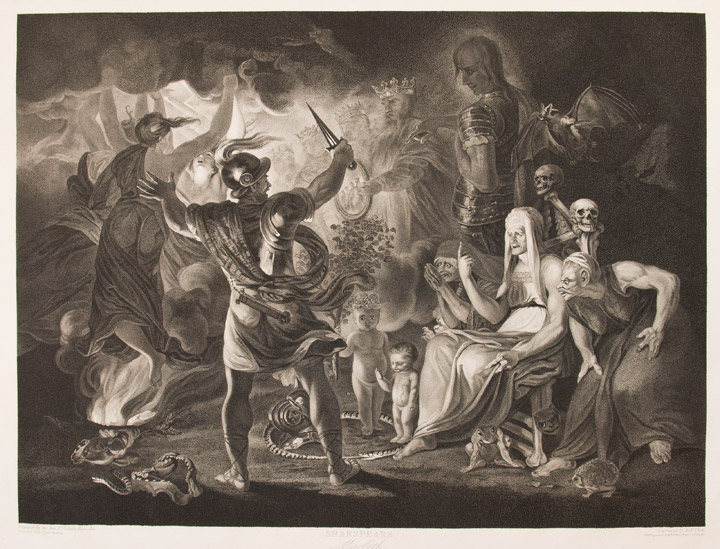 (REYNOLDS, Sir Joshua engraved by Robert THEW)
Omens and Predictions
Shakespeare uses imagery extensively to set the mood and theme in Macbeth. However, the delineation between what is ‘real’ and what are evidently literary devices used by Shakespeare to establish the plot is blurred. Keeping in mind that Tygstrup postulates that there are no facts but only contexts where facts are accepted, we can see how Shakespeare uses imagery to create a world that is relevant and real to his audiences of that age and era although they may not be as meaningful to us today. There are two approaches in distinguishing what is objectively ‘real’ in Macbeth.
Firstly, if we refer to what Tygstrup says, the reality should be contextualised and thus narrated. For example, let us consider Lennox’s account of the night of Duncan’s murder without prior knowledge of the event,”The night has been unruly: where we lay…Was feverous and did shake.” (scene 3, 54-61). The strange occurrences of that night clearly is a ‘narrative…through which [Shakespeare’s intended audience] make sense of facts’ (Tygstrup 87), that is, Lennox’s experience would be taken as an omen of Duncan’s death and of Macbeth’s betrayal. We can therefore contend that it is objectively real.
Secondly, if it can be said that the shared beliefs of Shakespeare’s intended audience is considered to be ‘a system of acknowledged truths reproduced through the everyday life-world of individuals’ which becomes ‘the collective universe of imagination inhabiting their minds’ (Tygstrup 88); we can easily see how other accounts given by the Old Man and Ross (Act II, scene 4) could be considered just as objectively ‘real’ as Lennox’s version since ‘systems of truth not only through the inclusion of facts in their interpretative grids, but also through tailoring them to fit these grids’ (89). These strange and unnatural occurrences are therefore significant as well as necessary in establishing a plot that Shakespeare had intended for these omens to be ‘real’ in their truest sense.
APPARITIONS
During the Elizabethan era, much of the beliefs of the world changed, even the main religion changed from catholicism to protestantism.(Mullan, 1) Protestants did not believe in souls being able to escape from purgatory therefore not in ghosts whereas Roman Catholicism did believe in ghosts. It is assumed by Goodman “the world we experience is always already made from other worlds”.(2) Therefore the world of Macbeth must reflect the world in which there are no ghost. We can make this assumption since only Macbeth is able to see the apparitions in the play. With that in mind, while analysing the scene in which Banquo is seen (Act 3 Scene 4) we can deduce that the mental state of Macbeth is unhinged from his act of violence and is riddled with guilt. The confirmation of Lennox not seeing the ghosts confirms that the ghost is all in Macbeths mind.
Macbeth: The table’s full.
Lennox: Here is a place reserved, sir.
Macbeth: Where?
Lennox: Here, my good lord. What is’t that moves your highness?
(Act 3 Scene 4)
Neither of the guest at the banquet sees the ghost, with Lady Macbeth trying to calm things down. Although that she cannot see the ghost it is hinted that she can perceive what Macbeth is seeing when she tells him to calm down and gather his courage. “Oh, proper stuff! This is the very painting of your fear! /…/ You look but on a stool.” (Act 3 Scene 4) Which further impose the idea that his vision is a part of his madness.
Furthermore, on the night when Macbeth is set to do the deed he sees and describes a dagger which is presumably used to murder King Duncan with. “Is this a dagger I see before me, /…/ It is the bloody business which informs, Thus to mine eyes” (Act 2 scene 1). Because we are given the information “(He draws a dagger)”, it could have been easy to say that the dagger he talks about is a fact. However, it cannot be said for sure considering that Macbeth later goes to Lady Macbeth who says “Why did you bring these daggers from the place” (Act 2 Scene 2) and has said earlier “I laid their daggers ready, He could not miss ‘em” which implies that the daggers Macbeth brought to their chamber are the daggers Lady Macbeth had put in the chamber. Macbeth draws a dagger before he slays King Duncan and not in the chamber, and that therefore the dagger might not have existed at all. It would have been easier to believe that the dagger is real if we, as the audience, are not aware that Macbeth’s hallucinations are visible to us and that he is not a reliable source for the establishment of facts in the play. This leaves us with the question of whether the first dagger is real or not.
*
As realized through applying the theory of Worldmaking to Macbeth, to determine fact and truth, we can recognize that not every occurence in one world will be a fact, since this will require proof of its authenticity. For a fact to be true, we need more than one witness considering that the testimony may be unreliable. In the case of Macbeth, where certain questionable incidents occur, we have established that certain supernatural events can be perceived as fact and not mere devices used by Shakespeare purely for their theatrics.
*
Works cited
Atherton, Carol. “Character analysis: The Witches in Macbeth”. British library, 2017
https://www.bl.uk/shakespeare/articles/character-analysis-the-witches-in-macbeth
Goodman, Nelson. Ways of Worldmaking, Hackett publishing company, 1988, United States of America.
Mullan, John. “Ghosts in Shakespeare”. British library, 2016, https://www.bl.uk/shakespeare/articles/ghosts-in-shakespeare#
“The Use of the Supernatural in Macbeth by William Shakespeare”. Bartleby.
https://www.bartleby.com/essay/The-Use-of-the-Supernatural-in-Macbeth-PKCRFQPYTC)
Tygstrup, Frederik. “The Politics of Symbolic Forms” Cultural Ways of Worldmaking. Edited by V. Nünning, A. Nünning and B. Neumann, Walter de Gruyter GmbH & Co, 2010, Germany.
*
Written by: Sonia Prado, Maud Koenders, Julia Lindkvist, Mabel Hall, Cathrine Flymén, Chantal Svensson
Header photographed by Maud Koenders
 Worldmaking 4: